01
Single inbox across all agent systems
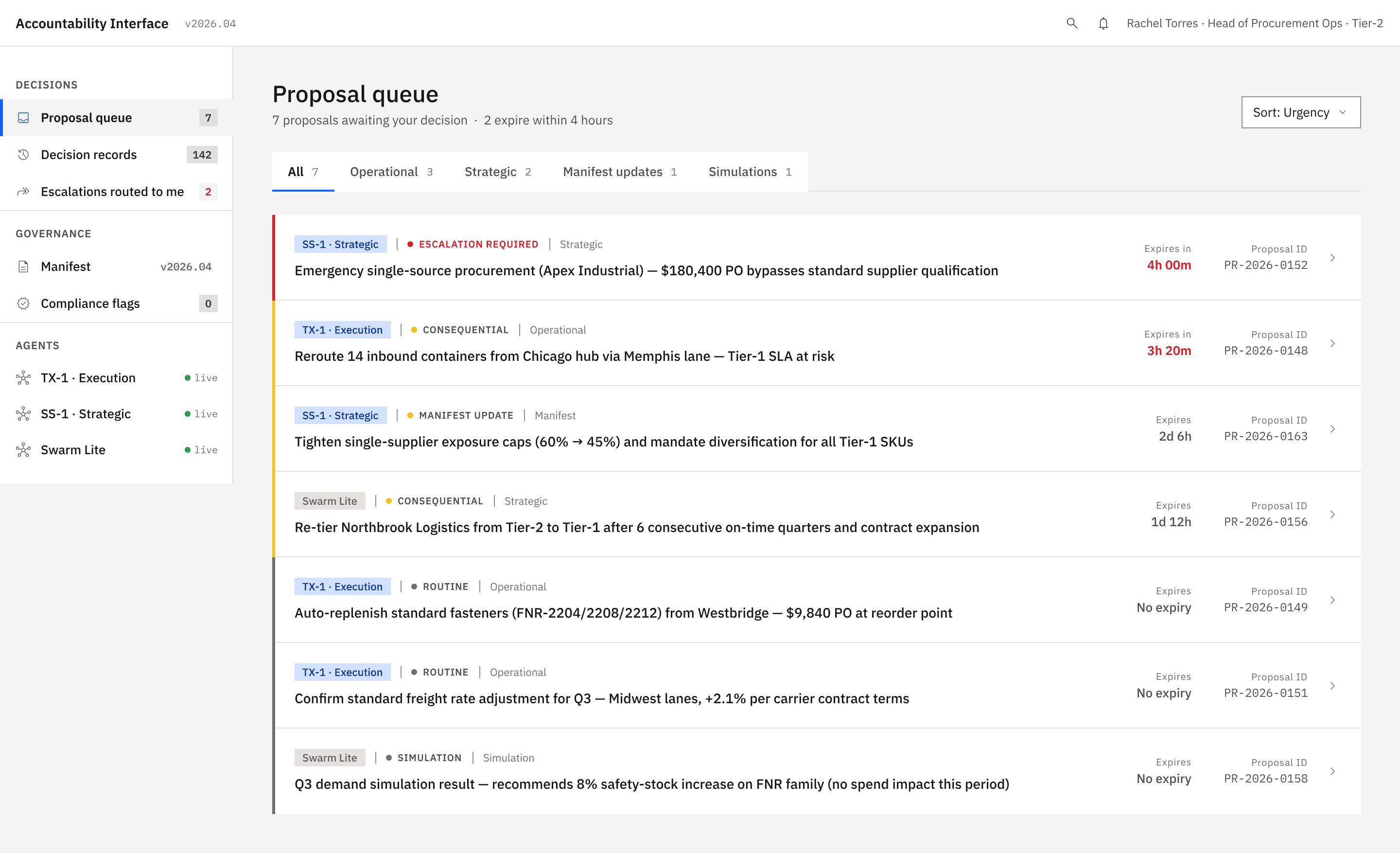
TX-1, SS-1, Swarm Lite, and future systems submit through one schema. The operator sees one queue, sorted by urgency, with decision-type accent strips telegraphing classification before they read a word.
The interface serves three distinct readers — the operator deciding, the regulator auditing, and the engineer wiring a new agent system in. Each group's needs are surfaced explicitly rather than hidden in a single feature list.
TX-1, SS-1, Swarm Lite, and future systems submit through one schema. The operator sees one queue, sorted by urgency, with decision-type accent strips telegraphing classification before they read a word.
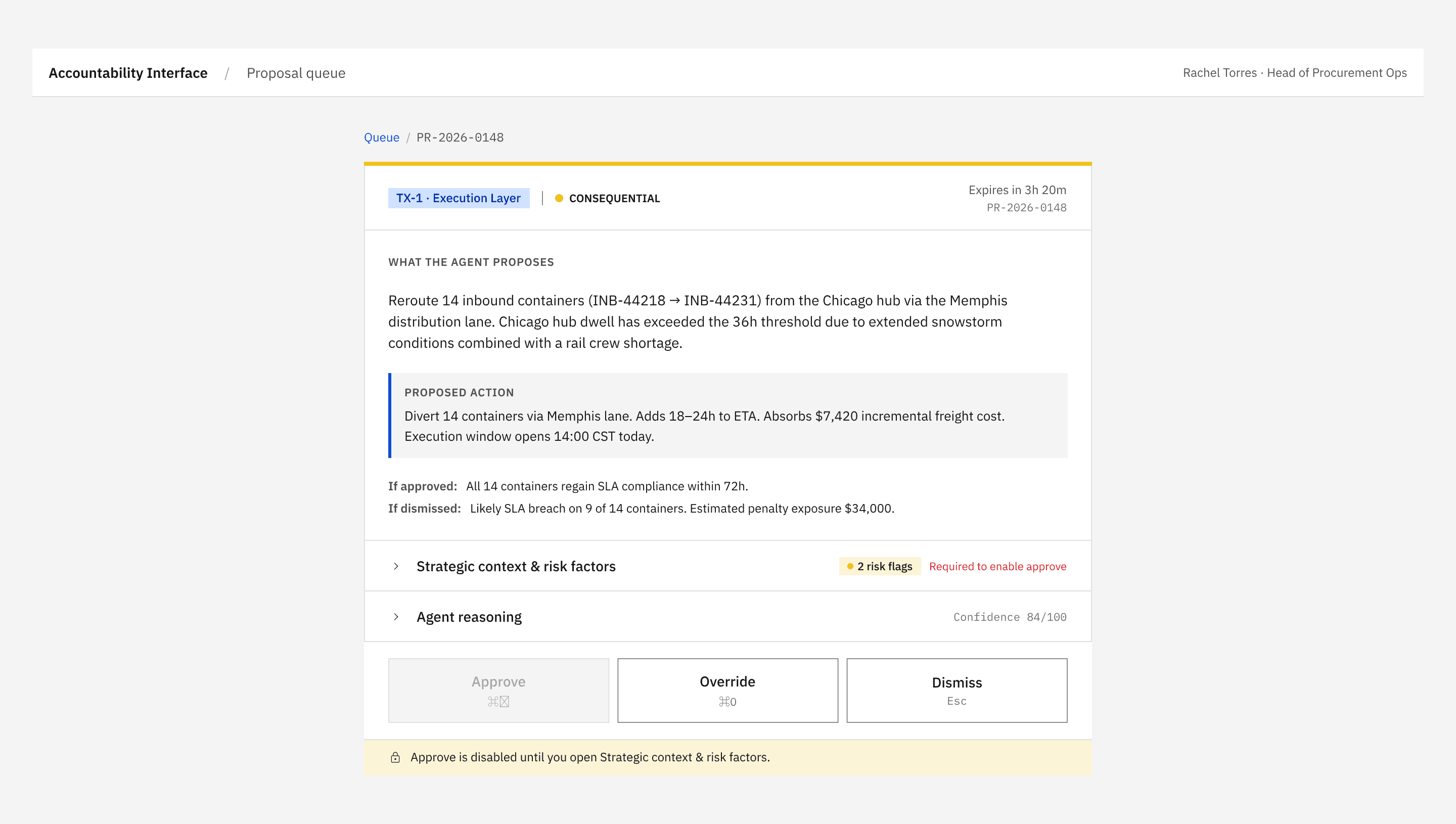
Approve is disabled on every consequential card until the Strategic Context block has been opened. A subtle interaction cost, applied only where stakes are high.
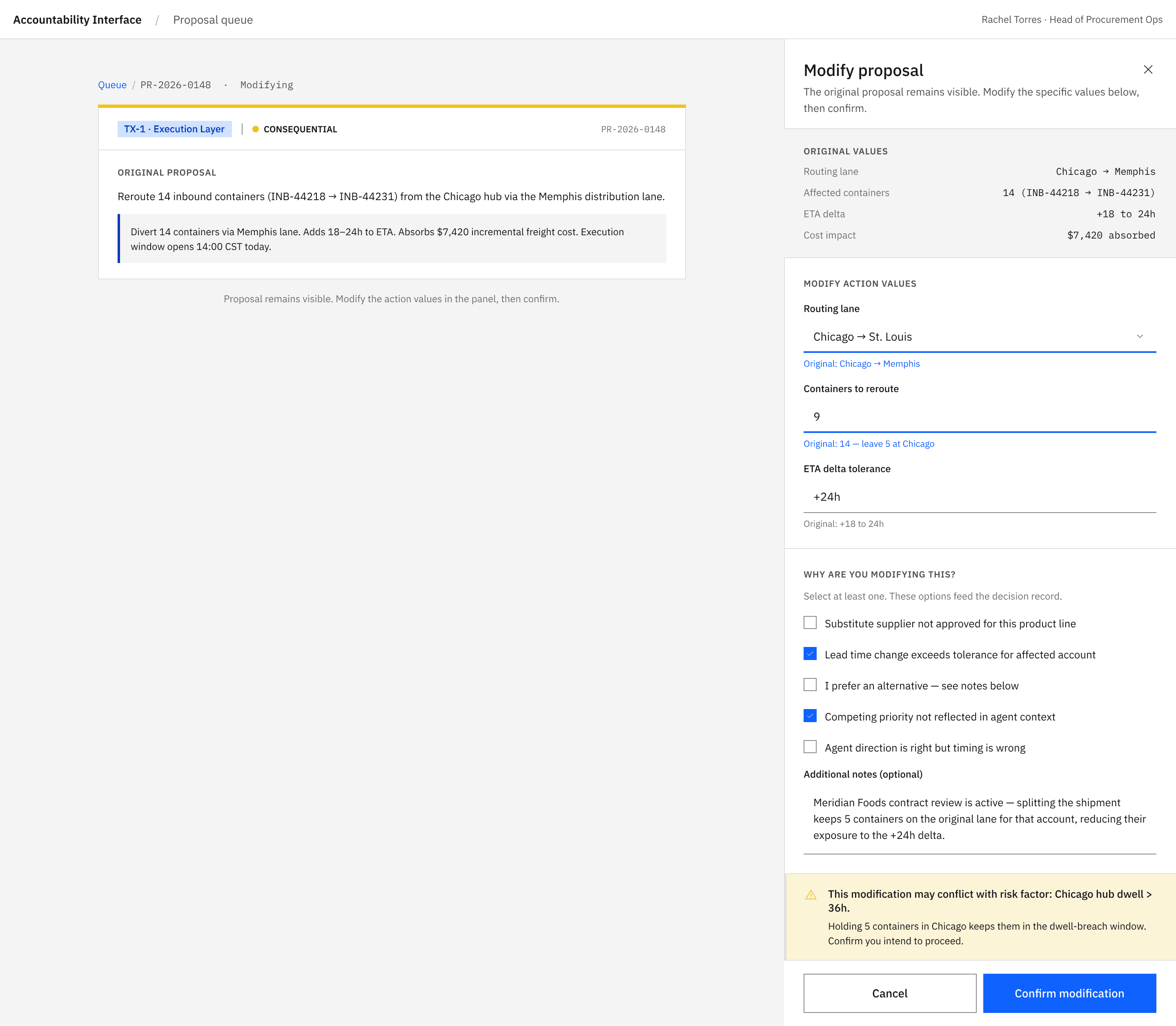
Override Panel surfaces alongside the card with the original action visible. The operator changes specific values, captures rationale, acknowledges conflicts — both the original proposal and the executed modification are preserved.
Approve, Override, and Dismiss are visually identical. Per ADR-006, no action is larger, more prominent, or more coloured than the others. Approval is not the default.
The exact proposal shown to the approver is captured verbatim. Six years later, an auditor opens the record and reads the same page. Not a reconstruction. The bytes.
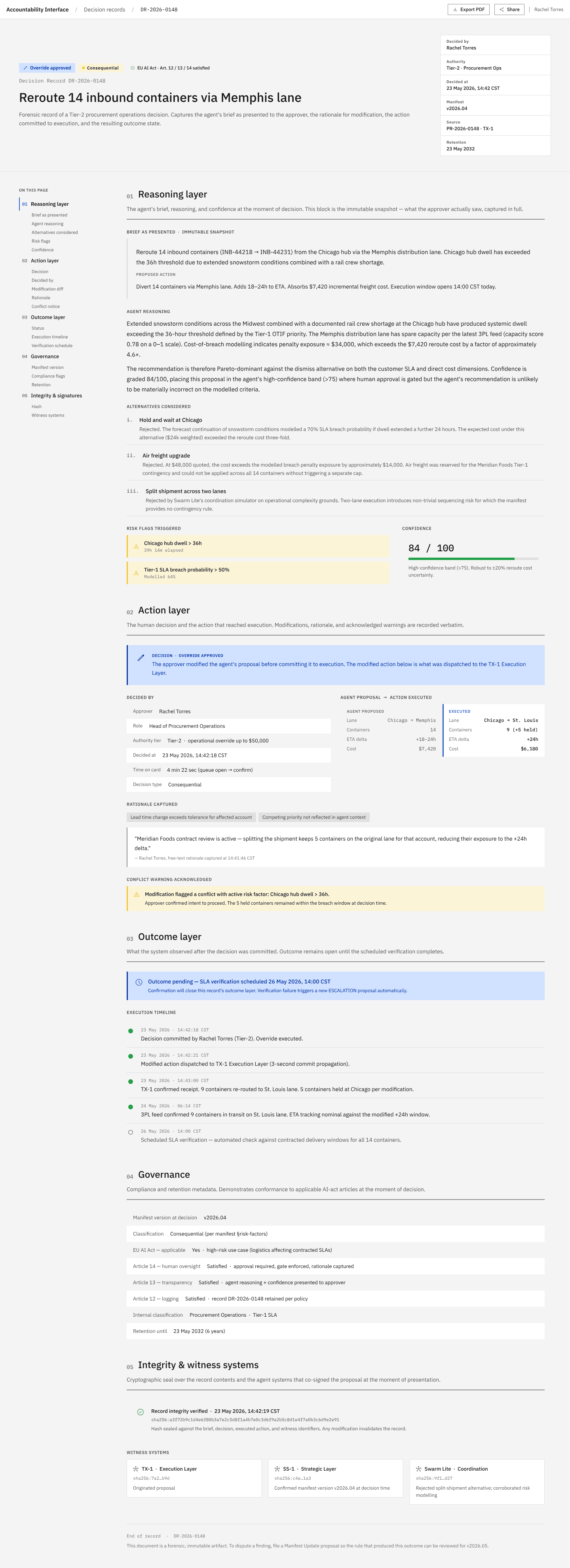
Every decision record is hashed over its sealed fields (reasoning + action + governance) at commit time. Any modification invalidates the record. The hash is rendered on the document — an auditor can verify independently.
Article 12 (logging), Article 13 (transparency), Article 14 (human oversight) — captured-brief + captured-rationale + gate-mechanic + sealed-record satisfies all three, provably, at the moment of decision.
Every record carries the manifest version it was made against. When rules change, decisions made under the old rules stay attached to the old rules. No retroactive reinterpretation.
Proposal and DecisionRecord interfaces are stable across TX-1, SS-1, Swarm Lite, and any future system. Adding a new system reduces to: serialize → POST /api/proposals.
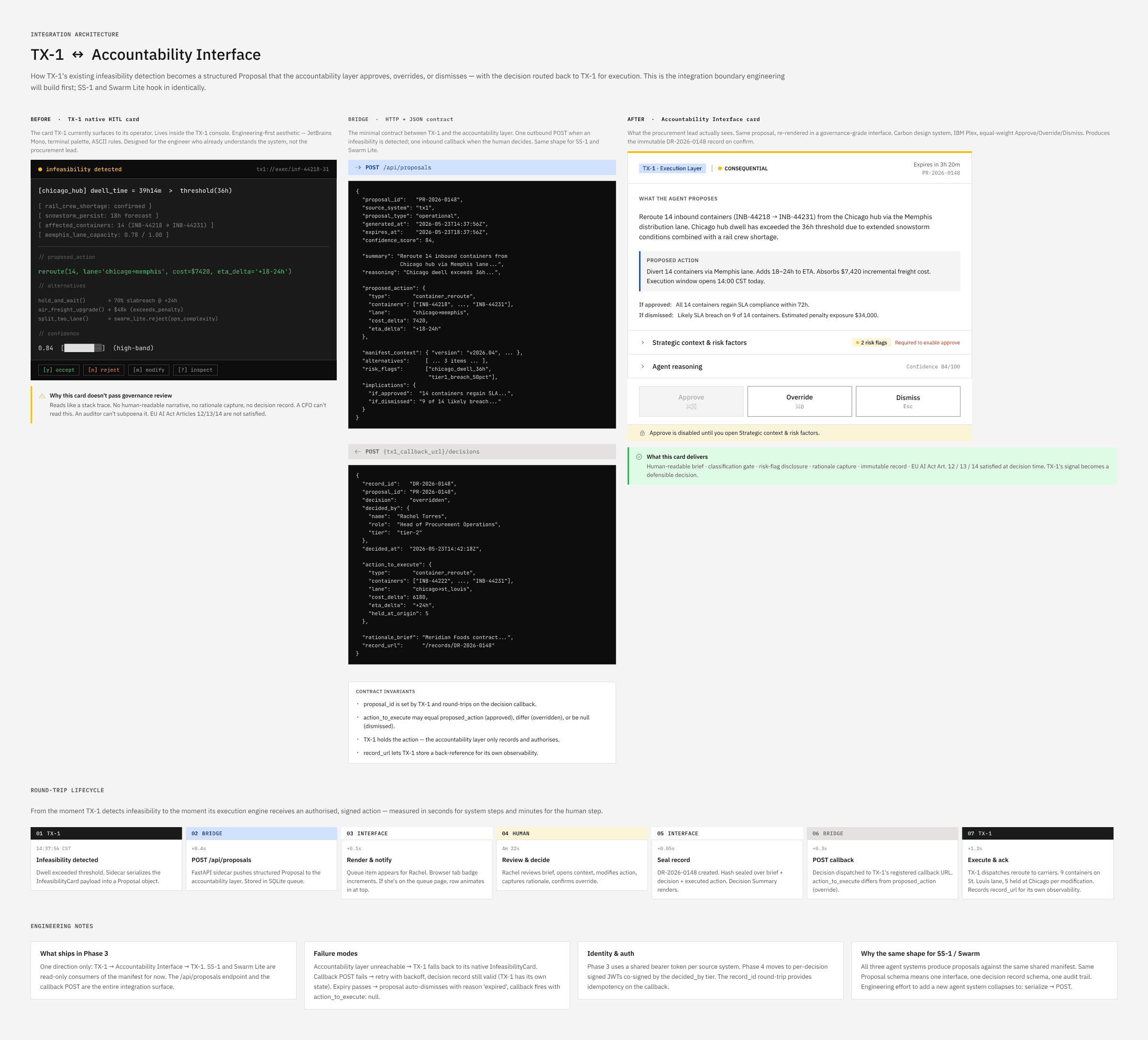
Tiny portable backend. Boots in 250ms. POST proposals in, GET them out, commit decisions back to source systems via callback URLs. SQLite for Phase 3 — swappable for Postgres in a five-line change.
Pure CSS using Carbon design tokens. No Tailwind. No rounded corners on data surfaces. IBM Plex Sans + Plex Mono. Engineering can drop in real Carbon React components — they just work.
Eleven features sound abstract. Five minutes in the live demo makes them concrete. The Chicago Bottleneck scenario is pre-loaded.
Open the demo →