Approval is not the default
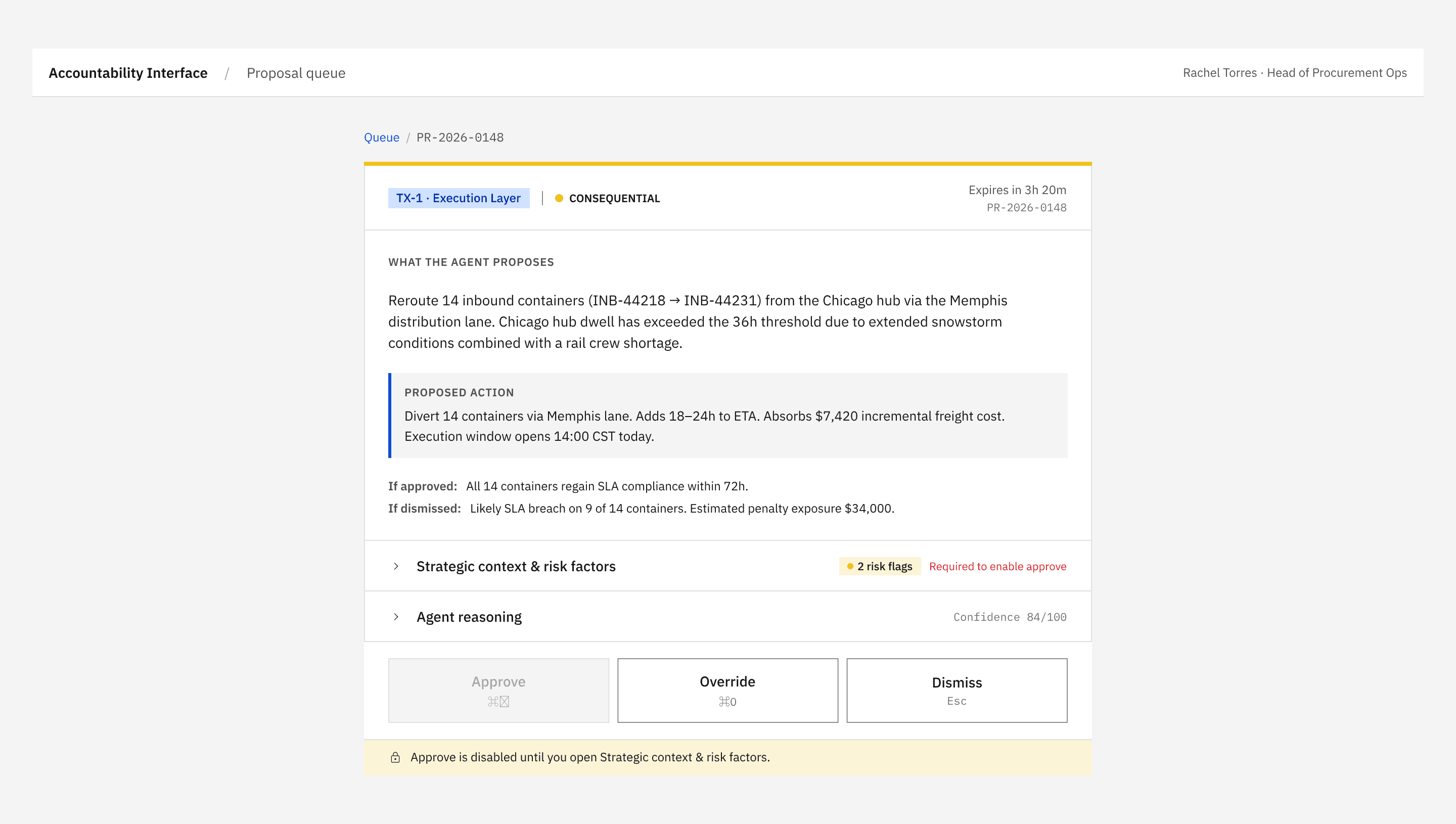
Approve, Override, and Dismiss carry equal visual weight on every card. For consequential decisions, Approve is gated until the strategic context has been opened — preventing rubber-stamping by design.
The interface human decision-makers use to approve, override, or dismiss AI agent proposals — and produce an immutable record that satisfies the EU AI Act Articles 12, 13, and 14 at the moment of decision.
Overview · 46s · narrated · unmute for sound
Approve, Override, and Dismiss carry equal visual weight on every card. For consequential decisions, Approve is gated until the strategic context has been opened — preventing rubber-stamping by design.
The exact proposal shown to the approver is captured verbatim and sealed in a SHA-256 hash. Six years later, the record renders the same — what they saw, what they decided, what was executed.
Every decision records the manifest version it was made against. When rules change, you can prove which rules applied to a given decision. No retroactive reinterpretation.
TX-1, SS-1, and Swarm Lite all submit through the same schema. Records carry witness hashes from each system that corroborated the proposal at decision time.
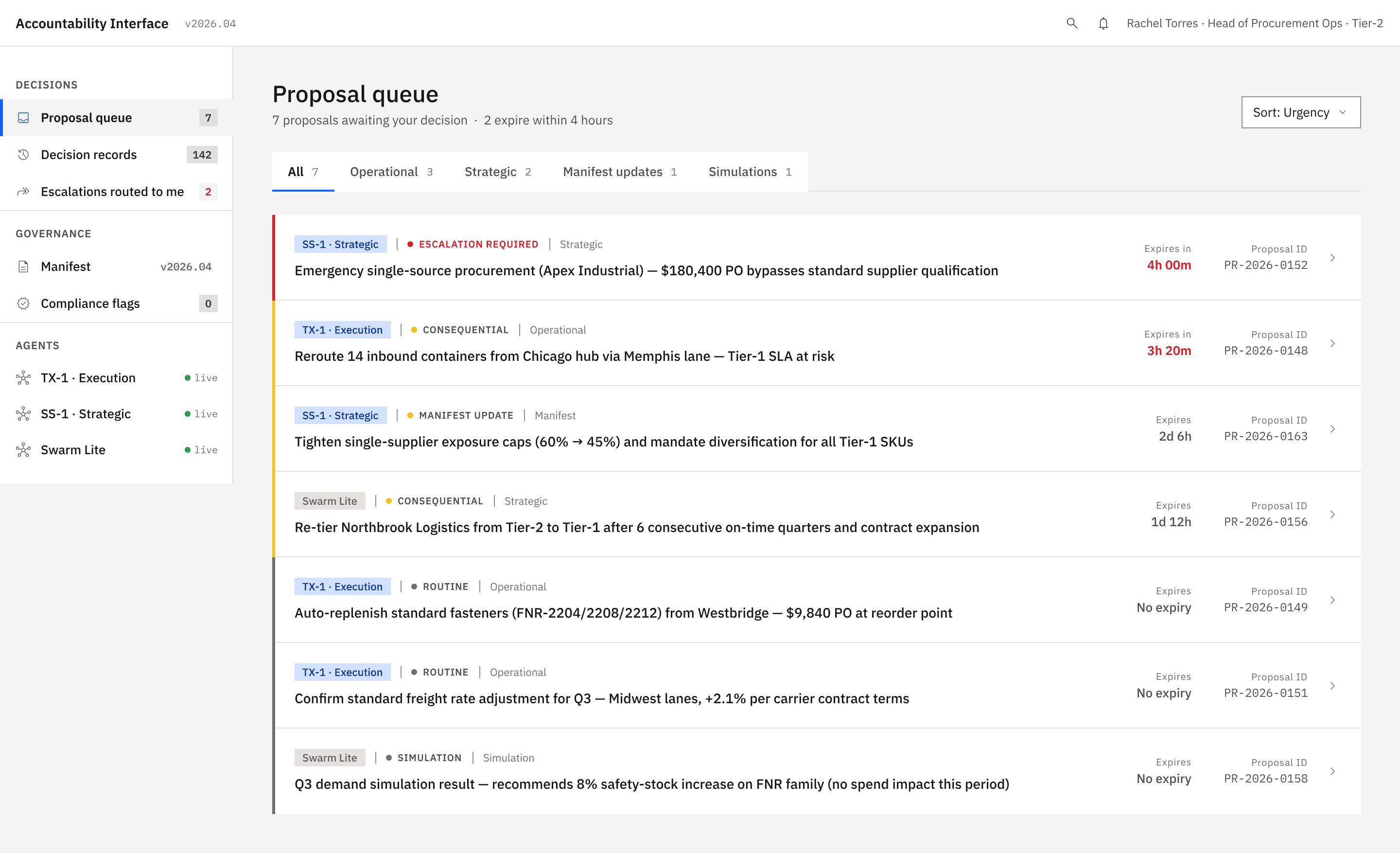
Proposals arrive from TX-1, SS-1, and Swarm Lite into a single inbox. Accent strips telegraph decision type before the user reads a word. Urgent expiries surface in red.
Approve is greyed and locked. The strategic context block must be opened first. This is the mechanism that prevents rubber-stamping on consequential decisions.
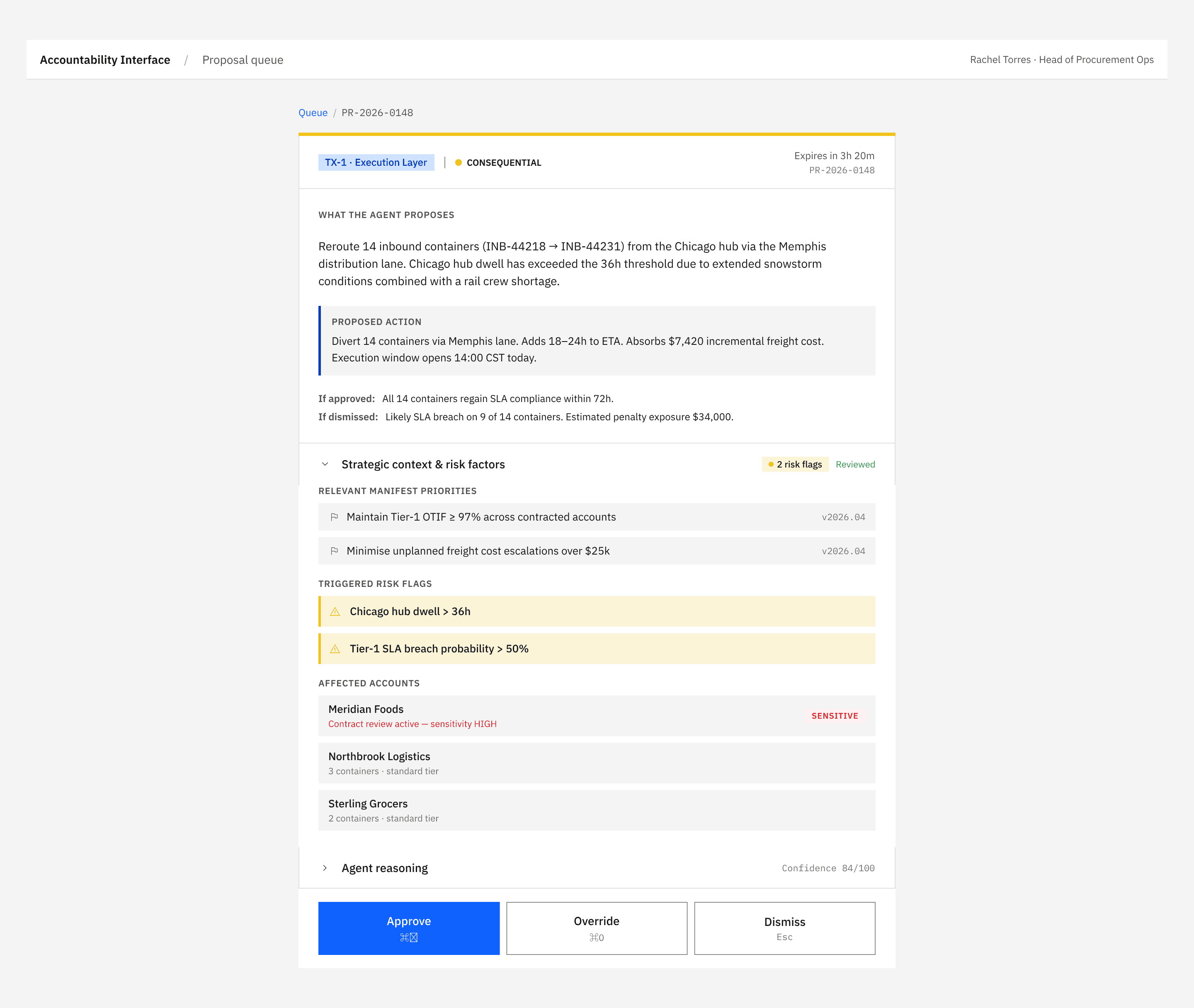
Manifest priorities, triggered risk flags, and affected accounts surface. Sensitive accounts carry visible badges. Reviewed flips green. Approve activates.
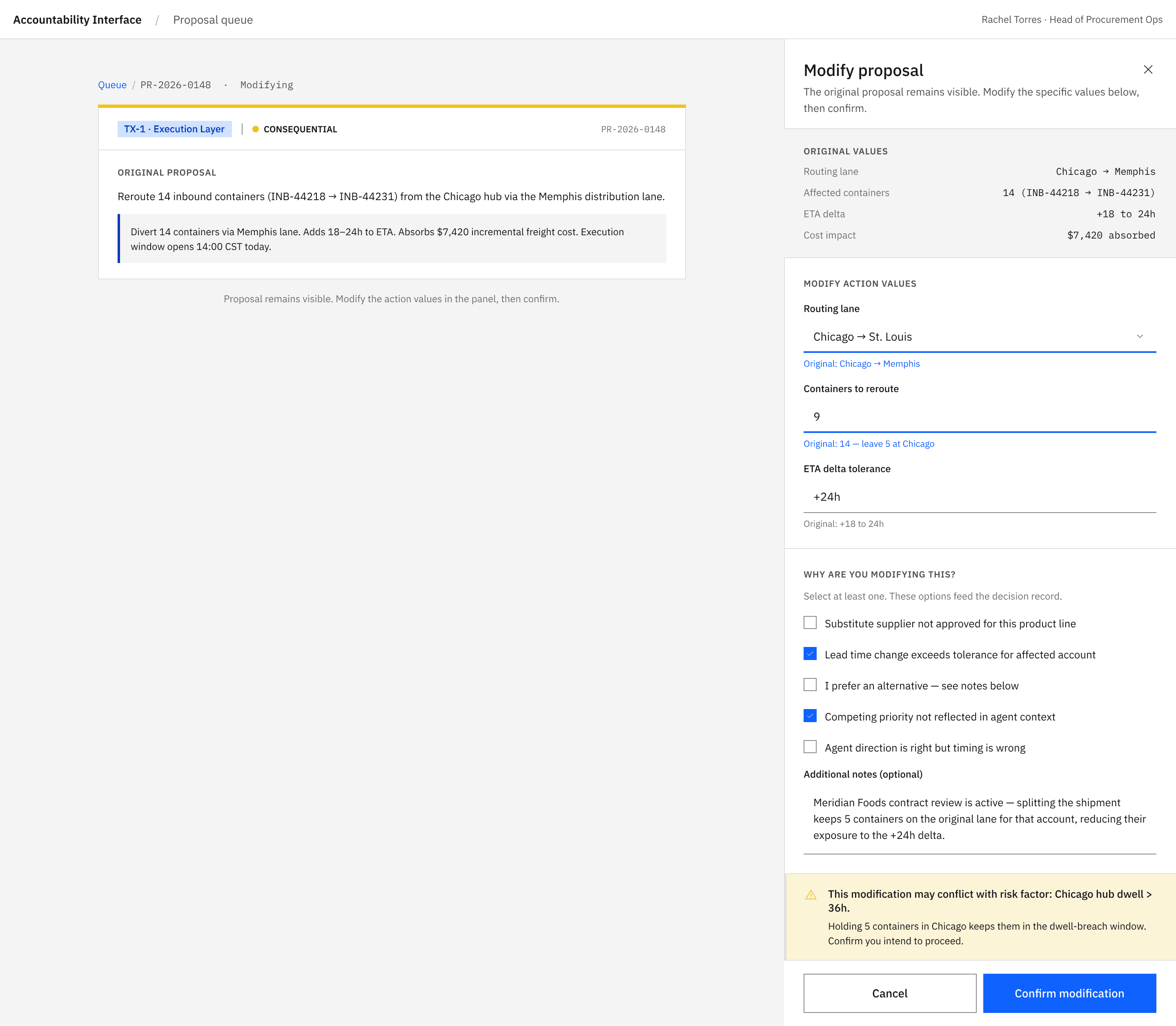
Modify the action values, capture rationale, acknowledge conflicts. Both the original proposal and the modified one survive in the record. The agent is not punished for being wrong — both states are useful.
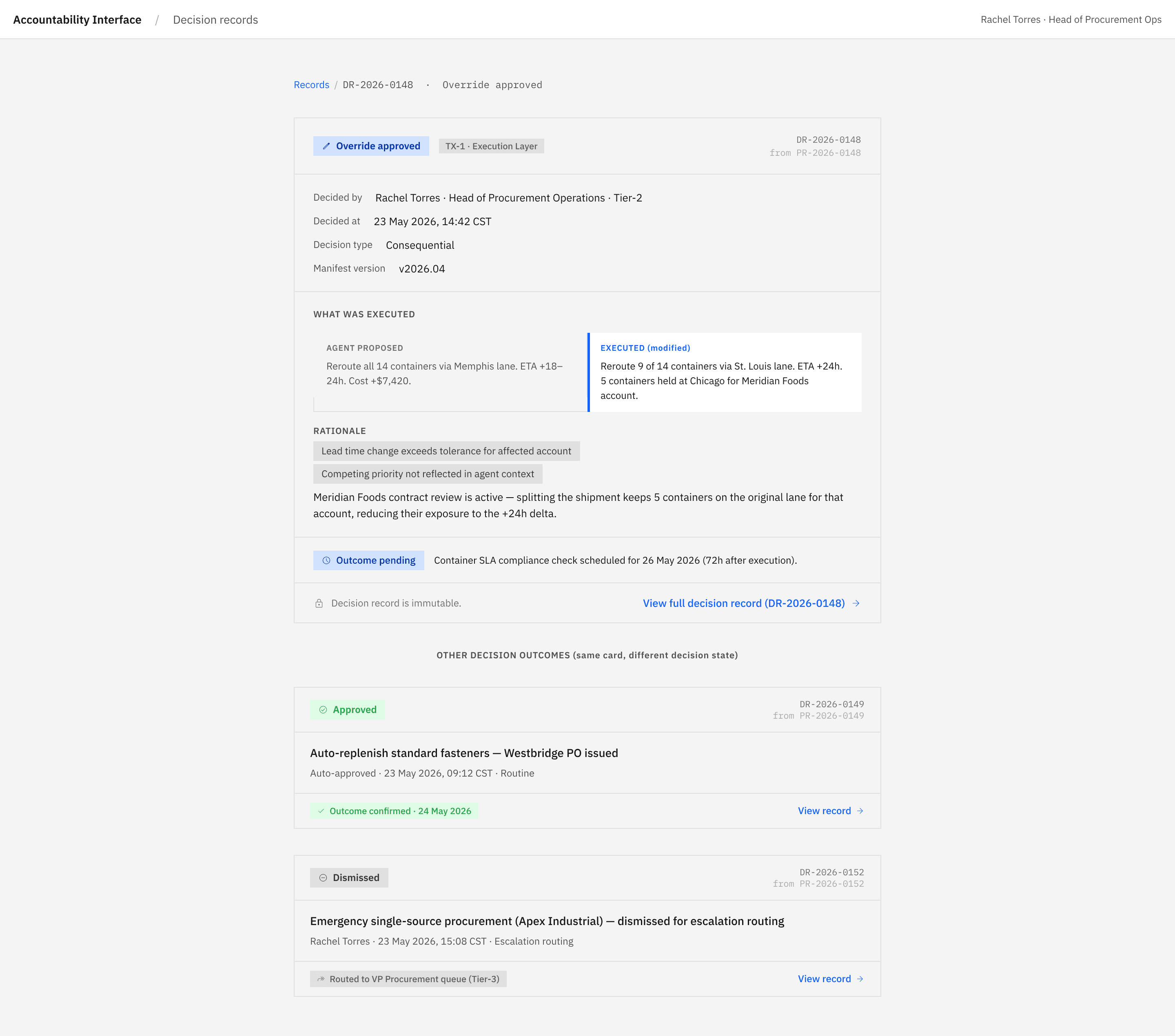
Card transitions to an immutable summary. Agent proposed vs. executed, side-by-side. Rationale captured. The decision record is sealed with a SHA-256 hash.
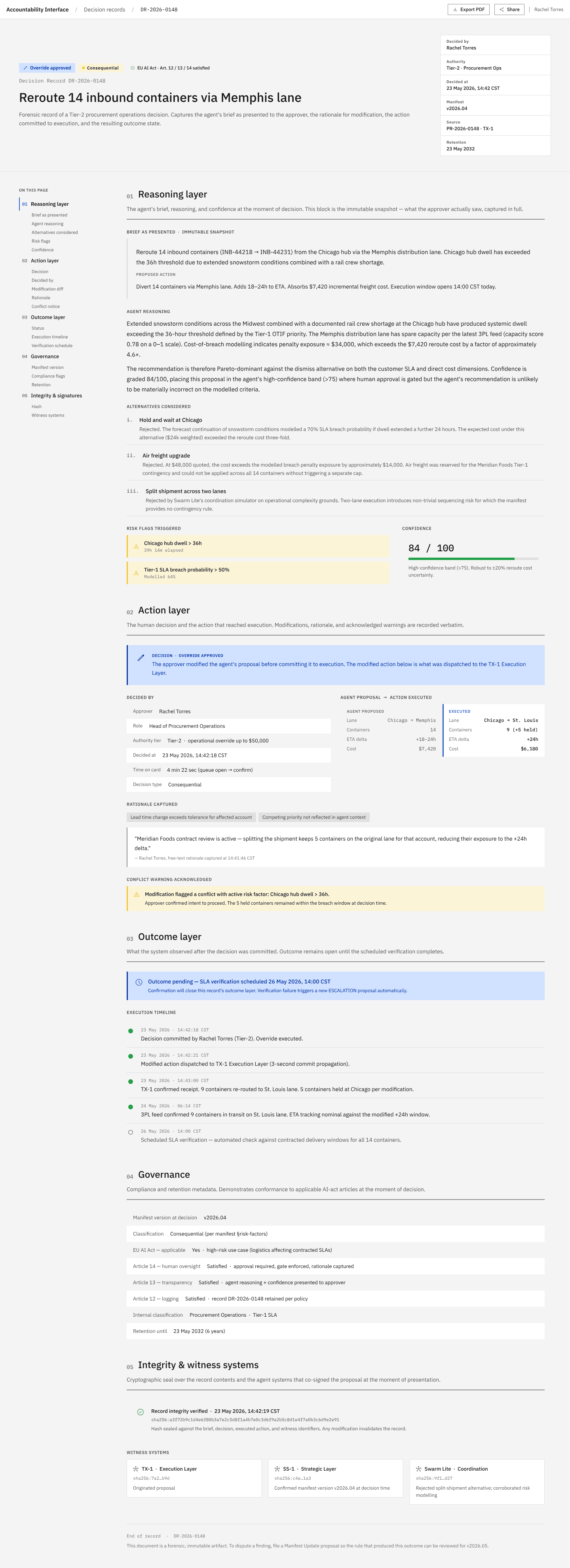
Six years later, audit opens the record. Brief as presented. Reasoning. Alternatives. Risk flags. Decision. Rationale. Action executed. Outcome. EU AI Act articles satisfied at decision time.
Head of Procurement Operations at a mid-market manufacturer. Her AI agents make supply-chain decisions every hour. Her CFO needs a board-ready governance narrative — not a log file — by the quarterly review.
I have agents making thousands of routing decisions a day. The board doesn't want a stack trace — they want to know that when a decision affected a Tier-1 contract, a person looked at it and chose.
When the auditor asks why did you approve this, I need to open one document. Not seventeen Slack threads.
I don't want to slow my agents down. I want to slow myself down — but only on the decisions that actually matter.
Watch the auto-driven walkthrough first to see the full flow in about forty seconds — or jump straight into the live app and run the Chicago Bottleneck scenario yourself. No signup required for either.